
Disinformation campaigns are strategically planned efforts by nation-states, hacktivists, or cybercriminals to spread falsehoods for political, economic, or strategic gains. These campaigns target governments, corporations, and critical infrastructure to erode trust, disrupt operations, and magnify the effects of cyberattacks. Their prevalence and sophistication have grown with the advent of advanced digital technologies.
Why this matters to AnnexVault
This report shows how false or misleading information can shape decisions before facts are clear. Evidence review helps separate what is known from what is being amplified.
Objectives of Disinformation Campaigns
The primary goals of disinformation campaigns include influencing political outcomes, destabilizing societal trust, causing economic sabotage, and amplifying the impact of cyberattacks. Examples include Russia’s use of disinformation during the 2016 U.S. presidential election to polarize public opinion and create discord, as well as campaigns undermining vaccine efficacy during the COVID-19 pandemic to erode public trust in health institutions.
Tactics and Techniques
Disinformation campaigns use various methods such as fake social media accounts, deepfakes, and hijacked legitimate platforms to lend credibility to false narratives. These techniques often exploit digital platforms to spread misinformation quickly and widely. Additionally, phishing and social engineering are employed to deliver disinformation directly to targeted individuals, while astroturfing creates the illusion of grassroots support for fabricated causes.
Recent Trends
Recent trends in disinformation include the integration of artificial intelligence and deepfake technologies, allowing for realistic but false content that is increasingly difficult to detect. Hybrid warfare tactics combine disinformation with cyberattacks, as demonstrated in Russia’s activities in Ukraine. Social media algorithms facilitate the rapid amplification of disinformation, often targeting specific demographics, while disinformation-as-a-service offerings on the dark web provide tailored campaigns for a fee.
Impact of Disinformation Campaigns
Disinformation undermines trust in governments, media, and corporations, leading to social polarization and reputational harm. Economic consequences include financial losses caused by market manipulation or damage to corporate reputations. Disinformation also poses national security risks, weakening societal resilience and complicating efforts to defend against cyberattacks.
Governments are primary targets of disinformation campaigns, which are often orchestrated by nation-states or political groups. These campaigns aim to manipulate public opinion, destabilize institutions, and erode trust in governmental operations. Their integration into cyber operations makes them a critical concern for national security and public trust.
Objectives of Disinformation Campaigns
Disinformation campaigns target governments to achieve political, economic, or strategic gains. Objectives include influencing public opinion, undermining election integrity, and destabilizing public trust in institutions. For example, Russia’s Internet Research Agency (IRA) used social media campaigns during the 2016 U.S. presidential election to polarize voters and create discord. Similarly, China has deployed disinformation to shape global narratives about its policies in Hong Kong and Xinjiang.
Tactics and Techniques
Disinformation campaigns employ sophisticated tactics such as social media manipulation, deepfakes, and targeted phishing. Techniques include creating fake accounts to amplify false narratives, leveraging AI-generated content to fabricate convincing media, and using phishing emails to directly deliver disinformation to high-value targets. Information laundering, where false narratives originate from fake websites and later gain credibility through legitimate outlets, further complicates defense efforts.
Impact on Government Defenses
Disinformation campaigns significantly affect government operations by undermining election integrity, eroding public trust, and creating national security risks. During the COVID-19 pandemic, disinformation about vaccine efficacy disrupted public health responses. National security is also at risk, as disinformation can incite unrest or sow confusion during emergencies. Geopolitically, campaigns like China’s Belt and Road Initiative narratives aim to influence global perception while silencing criticism.
Recent Trends
Recent trends show an increasing integration of disinformation with hybrid warfare tactics, combining traditional cyberattacks with coordinated narratives. The use of artificial intelligence has enhanced the scale and sophistication of these campaigns, enabling realistic deepfakes and automated content distribution. Nation-states are also collaborating with cybercriminal groups to amplify disinformation while maintaining plausible deniability. Localized disinformation targeting smaller, niche communities has become more prevalent, making detection and mitigation more challenging.
The financial services industry is a prime target for disinformation campaigns due to its critical role in the economy and its reliance on trust and credibility. Disinformation in this sector often aims to manipulate markets, damage reputations, misinform customers, or exploit regulatory vulnerabilities, leading to significant financial and reputational losses.
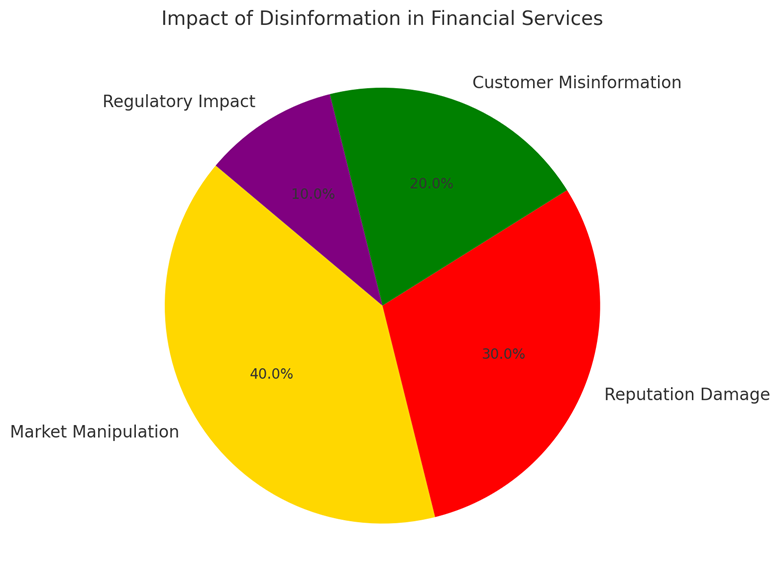
Disinformation campaigns in financial services employ various tactics:
- Market Manipulation: Disseminating false information about stocks or companies to influence share prices. For example, coordinated social media campaigns can create panic or euphoria among investors.
- Reputation Damage: False claims about fraud, product failures, or regulatory breaches are used to erode trust in financial institutions.
- Customer Misinformation: Misinformation campaigns target customers directly, such as false messages about account closures or urgent financial actions.
- Exploitation of Regulatory Gaps: Disinformation campaigns can exploit regulatory delays or ambiguities, spreading false claims about compliance or enforcement actions.
To combat disinformation campaigns, financial institutions must adopt a multi-layered approach:
- Enhanced Monitoring: Utilize AI-driven tools to detect disinformation trends and identify false narratives in real-time.
- Public Awareness: Educate customers on recognizing and avoiding false financial claims.
- Collaboration with Regulators: Work closely with regulatory bodies to address disinformation and minimize its market impact.
- Rapid Response Teams: Establish dedicated teams to counter disinformation by providing accurate and timely information.
- Policy Enforcement: Engage with social media platforms to remove false content and reduce amplification.
Disinformation campaigns targeting healthcare and pharmaceuticals exploit public fears, misinformation, and trust in medical institutions to achieve political, financial, or ideological objectives. These campaigns can undermine public health efforts, disrupt pharmaceutical development, and erode trust in healthcare systems. Nation-states, hacktivist groups, and profit-driven actors often orchestrate such campaigns, leveraging social media and other digital platforms to amplify their impact.
Key Objectives of Disinformation Campaigns
Disinformation in healthcare and pharmaceuticals often serves specific goals:
- Undermining Public Health Initiatives: False narratives about vaccines, treatments, or healthcare policies can discourage public participation and compliance.
- Example: During the COVID-19 pandemic, disinformation campaigns spread false claims about vaccine safety, leading to vaccine hesitancy.
- Economic Sabotage: Competitors or nation-state actors may disseminate false information to damage the reputation of pharmaceutical companies or disrupt markets.
- Example: False claims about drug recalls or side effects can lead to drops in stock prices and reduced consumer confidence.
- Political Influence: Disinformation campaigns can exploit healthcare crises to sow distrust in governments and their handling of public health issues.
- Example: Narratives questioning the credibility of global health organizations like the WHO during the pandemic.
- Exploitation for Financial Gain: Cybercriminals often use disinformation as part of phishing schemes, directing individuals to fake websites to sell counterfeit drugs or steal personal data.
Disinformation campaigns in healthcare and pharmaceuticals pose a significant threat to public health, economic stability, and societal trust. Proactive strategies, including technological tools, public education, and collaborative efforts, are critical to combating these campaigns. By addressing both the sources and effects of disinformation, healthcare systems can better protect themselves and the communities they serve.
Critical infrastructure, including energy, water, telecommunications, and transportation systems, is essential for societal and economic stability. Disinformation campaigns targeting these systems aim to destabilize services, manipulate public perception, and amplify the impact of cyberattacks. These campaigns often coincide with geopolitical conflicts or hybrid warfare, increasing their threat to national security.
Objectives of Disinformation Campaigns
Disinformation campaigns targeting critical infrastructure seek to disrupt services, undermine trust, and achieve geopolitical or economic goals. False narratives about system vulnerabilities or service failures create confusion, complicate response efforts, and destabilize public confidence. Nation-states frequently use these campaigns to weaken adversaries, as seen in Russia’s hybrid warfare tactics against Ukraine.
Tactics and Techniques
Disinformation campaigns leverage social media manipulation, phishing, deepfake content, and astroturfing to spread false narratives. These techniques often coincide with cyberattacks, such as ransomware or ICS breaches, amplifying their impact. For example, during the 2021 Colonial Pipeline ransomware attack, disinformation about prolonged fuel shortages intensified public panic and economic disruption.
Impact of Disinformation Campaigns
The impacts of disinformation on critical infrastructure include operational disruptions, public safety risks, economic losses, and national security threats. False narratives can delay incident response, induce panic behaviors, and damage the reputations of infrastructure operators. These campaigns also undermine confidence in a nation’s ability to safeguard its essential services.
Recent Trends
Recent trends include the use of AI-generated content, localized disinformation campaigns targeting regional vulnerabilities, and the integration of disinformation with supply chain exploits. Nation-states increasingly employ these tactics in hybrid warfare, combining disinformation with cyberattacks to destabilize adversaries.